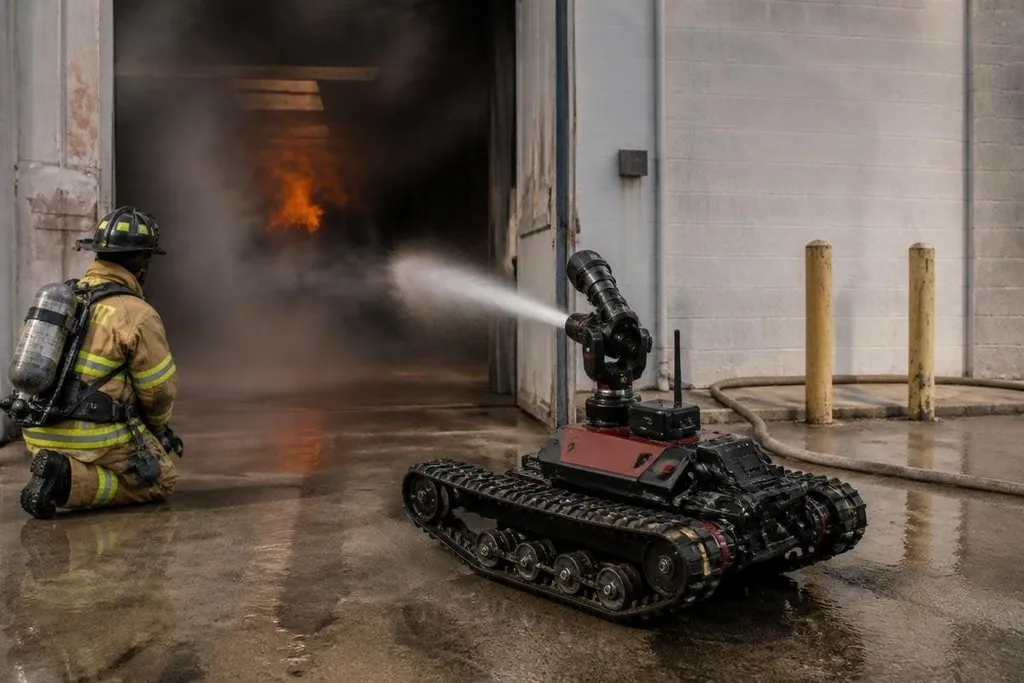
A firefighting robot can enter a burning building before a person does. That changes the first minutes of a fire, when heat, smoke, falling material, and poor visibility make rescue work most dangerous. The real question is where a robot can help, and where a trained crew still has to take over.
- Remote operation can keep firefighters outside the hottest rooms.
- Cameras, thermal sensors, and gas sensors can give crews a wider view.
- Rescue work still depends on reliable links, power, access, and human decisions.
What the robot would do
A tracked robot could move through a factory, tunnel, warehouse, or damaged building while an operator stays at a safe distance. Its cameras could send video to the control station, while a thermal camera could show heat that ordinary video misses.
The robot could also carry a hose, spray water or foam, move small objects, and check rooms before firefighters enter. A gas sensor could warn the crew about smoke gases, but that warning would only help if the sensor stays powered and the operator can read it in time.
A robot does not need to replace a firefighter to matter. Keeping one person out of a collapsing room is already a useful task if the robot can reach the room, send back clear data, and return without becoming another rescue problem.
The hard part is movement
Fire scenes are rough places for machines. Hoses cross the floor, stairs may be damaged, doors may be closed, and water can reduce traction. Smoke can block cameras, and heat can damage batteries, wiring, seals, and motor parts.
Remote control also depends on a stable radio link. Thick walls, underground spaces, and metal structures can weaken that link. If the video freezes or the controls respond late, the operator may lose the robot at the point where the crew needs its information most.
Autonomous driving can reduce the operator's workload, but it brings its own limits. It may follow a planned route and still meet a blocked doorway, a fallen beam, or a person lying on the floor. Human crews need clear control of the machine when conditions change.
Fire crews need to know what happens when a robot loses its camera view, control link, or route inside a burning building. Reports from Robot 24 can connect those questions with named machines, test sites, and dates before the article turns to the tasks that may save lives.
What could save lives
The strongest use case is risk reduction. A robot could check a suspected gas leak, inspect a hot corridor, look for movement through smoke, or send a thermal image before a crew crosses the threshold.
That information can change the order of work. Crews may find a safer entry point, send medical help to a known location, or decide that a room is too hot for a person to enter. The benefit comes from better timing and fewer blind steps, not from the robot acting alone.
Fire departments would also need training that matches the machine's limits. Operators must know how to read thermal images, manage a lost signal, protect the robot's battery, and hand control to another person during a long incident.
What remains unproven
No general claim about firefighting robots can stand without details about the robot, the building, the fire, and the task. A machine that works on a flat warehouse floor may struggle on stairs. A robot that can carry a hose may have less time for inspection because the hose adds weight and drag.
The cost also includes spare batteries, transport, repairs, software updates, training, and storage.
A department needs proof from drills that match its own buildings and fire plans. Video from a controlled test can show what a robot did once; it can't establish how often the system will work during real incidents.
I'd favor robots first for inspection and remote sensing, where their value is easier to check than a promise of fully autonomous rescue.
A buying checklist for fire departments
Before a purchase, check five points:
- Reach: Can the robot pass the doors, stairs, corridors, and floor surfaces found in local buildings?
- Heat and water: What temperature, spray exposure, and operating time does the maker document?
- Control link: Does the system keep working through concrete walls, metal rooms, and underground areas?
- Useful data: Can the crew record, review, and share thermal video, gas readings, and robot location?
- Recovery plan: Can firefighters pull the robot out if it stalls, loses power, or blocks an access route?
The next useful proof will come from drills that measure arrival time, control failures, sensor quality, and recovery work under fire-service conditions. Until departments publish those results, firefighting robots should be treated as remote tools for reducing exposure, not as replacements for the crew at the door.